
Supplying the coupler is half the job. We mobilise the machines, the supervisors and the operators, and take responsibility for the joint from bar end to torque wrench.
Bar ends are sawn or square cut on a suitable machine to give a flat end surface perpendicular to the axis of the bar.
We enlarge the end hydraulically by cold forging, so the cross-section after threading is never less than that of the parent bar.
We cut the parallel threads to the required profile and check them with pitch and Go/No-Go gauges. Threaded ends are proof load tested and punch marked.
Fix the coupler to the installed bar. Screw the free bar in. Tighten the joint to the torque specified for that diameter.
Which thread a bar gets depends on whether that bar can be turned on site.
A single thread length equal to half the coupler. Used where the TMT bar is short enough, or free enough, to be rotated into the coupler.
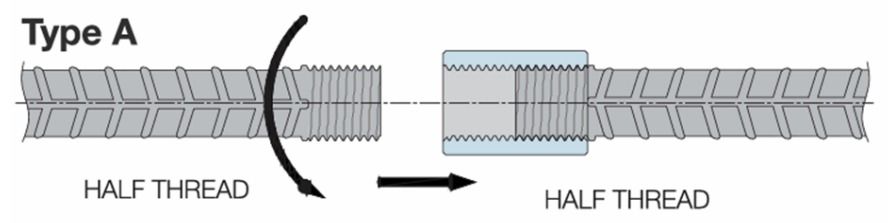
Thread length equal to the full coupler. Use it for long or large-diameter bars that cannot be rotated. The coupler winds back off the Type B bar onto the Type A bar and locked to the required torque.
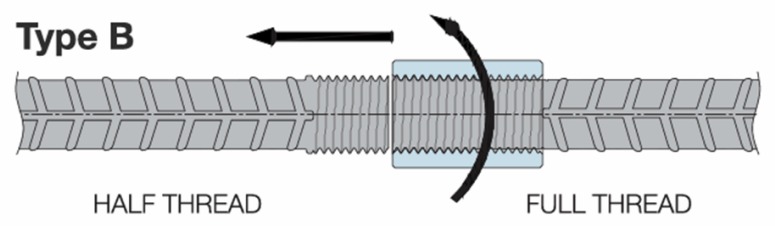
Thread both bar ends. Run the coupler onto the pre-installed member. Engage the free bar. Then tighten the joint with a calibrated wrench.
| Rebar diameter | Tightening torque |
|---|---|
| ≤ 16 mm | 100 N·m |
| 18 to 20 mm | 200 N·m |
| 22 to 25 mm | 260 N·m |
| 28 to 32 mm | 320 N·m |
| 36 to 40 mm | 360 N·m |
VUK imports and supplies the torque wrench. The values are those published by the wrench manufacturer.
The same equipment we design and build in Jetalpur is what turns up on your site, operated by crews who work with it every day.
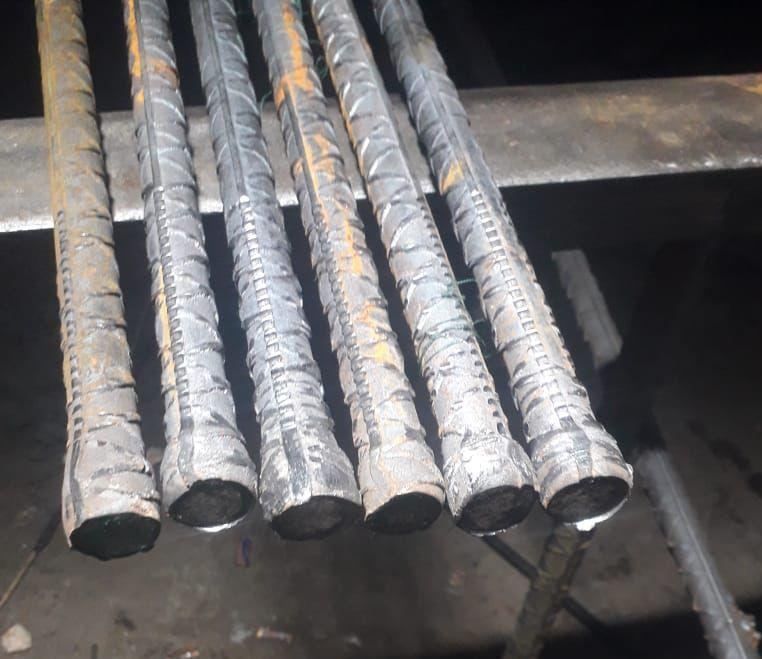 Cold forging the bar end
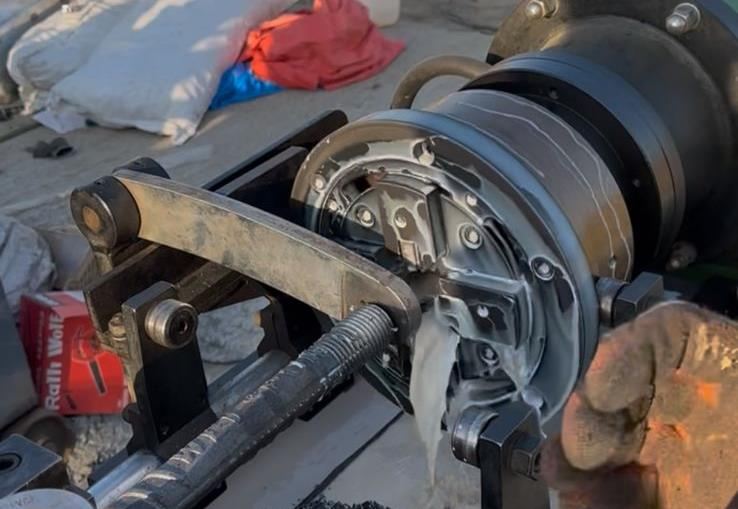 Parallel threaded ends
Send us the bar diameters, the quantities and the site location. You get a technical offer, a sample Material Test Certificate and a lead time, usually on the same working day.